Steamworks Documentation
Review Process
Your game's store presence and build will need to be reviewed by Valve's review team before they can be released on Steam. Store pages and builds each have their own release checklists that you will work on completing before being able to submit your game for review.
After you submit, a reviewer will let you know if any changes need to be completed. If none are necessary, you'll be ready for release. Please see our Release Options documentation for more information on how to release your product on Steam.
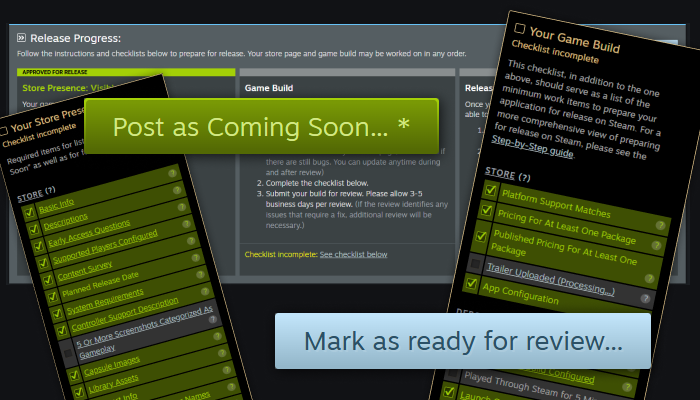
The recommendations here come from the same criteria that reviewers use when evaluating each component of a store page. Keep this guide handy as you progress through the items in your checklist, to ensure that your store page review goes as smoothly as possible.
The primary info about your game, including name, supported platforms, and supported languages. You can also include relevant legal information and set up any external websites that your store page will link to.
Tips for review:
Tips for review:
Learn more about the specifics of your content survey
Tips for review:
Learn more about how to set up the right planned release date
Tips for review:
You may also wish to add a recommended level of requirements, if the game has features or elements that are enhanced with better hardware.
For games that indicate VR Support as a feature, you will need to list all the VR platforms and devices that the game supports in the system requirements section on the Basic Info tab.
Tips for review:
Learn more about the various graphical assets that your game will have
Tips for review:
Tell customers which anti-cheat service your game uses. If you choose "Other", also give the service's English name.
The recommendations in this list come from the same criteria that reviewers use when evaluating and playing your build. Keep this guide handy as you progress through the elements of your checklist, to ensure that your build review goes as smoothly as possible.
Learn more about supported platforms
Tips for review:
Learn more about pricing
Learn more about trailers
Tips for review:
Learn more about uploading to Steam
Tips for review:
To complete this checklist item:
Learn more about common redistributables
Tips for review:
Learn more about packages
This is where you set a Workshop title and upload a header image on the Workshop page of your Steamworks settings.
Learn more about Steam Workshop
Tips for review:
This is where you'll set up all of the specific achievements, and ensure that they are working in conjunction with your build. We only test the qualities of the achievements. Your team will be responsible for ensuring they unlock correctly.
Learn more about achievements
Tips for review:
Set up Steam Input for your game under Application > Steam Input, or remove Steam Input API support from your store page.
Learn more about Steam Input
Tips for review:
Tips for review:
If your store page lists Steam Cloud, we check that saves sync between two computers. Prior to submission, a member of your team will be required to write a save file after playing the build you are submitting.
Learn more about Steam Cloud
Tips for review:
Learn more about localization
Tips for review:
Tips for review:
Tips for review:
If your game has in-app purchases, reviewers will make sure that it's set up correctly by purchasing something with Steam Wallet.
Learn more about in-app purchases
Tips for review:
Tips for review:
Once all your trading card assets are uploaded, click the edit link beneath "Release State" to configure your card drop settings and mark your assets as ready for review. Once set as ready for review, your cards will automatically appear in our queue to review by a Valve designer.
After your assets are approved, you'll see the status update on your Steamworks home page. You'll then be able to set the release state to "Released" and publish the items. You can check our Steam Trading Cards documentation for more information.
After you submit, a reviewer will let you know if any changes need to be completed. If none are necessary, you'll be ready for release. Please see our Release Options documentation for more information on how to release your product on Steam.
Submitting a Store Page for Review
The following guide is based on the Store Presence checklist that you must complete before submitting your store page for review.The recommendations here come from the same criteria that reviewers use when evaluating each component of a store page. Keep this guide handy as you progress through the items in your checklist, to ensure that your store page review goes as smoothly as possible.
Basic Info
The primary info about your game, including name, supported platforms, and supported languages. You can also include relevant legal information and set up any external websites that your store page will link to.
Tips for review:
- Include an English game name
Steam uses English as the default and only fallback language. Your game name will need English entered. If no English name is available, then enter your non-English name in the English field. - Have a consistent game name
Avoid using placeholders, and be sure that the name is consistent across other areas of your store page, such as in your graphical assets and descriptions. - Add your EULA in its own section
If your game has a EULA, it can be added specifically to the EULA section in your app admin panel: App Admin > Installation > EULA. Don't include a link or the entirety of the EULA into the Legal Lines section of the store page. - Make sure to test your external links
The store page Basic Info tab has a section to include your website and social media links. It's a good idea to double check that all of the links you've set up properly redirect from your store page.
Descriptions
The various text fields on your store page that let customers know what they should expect from your game.Tips for review:
- Descriptions should be detailed and on-topic
Customers use your store page to make informed and confident purchasing decisions, so make sure that you include a detailed and accurate description, including what to expect from the game and features players will encounter and interact with. Don't use your descriptions to talk about other games or link to other places. - Descriptions should be consistent
Before you are ready to submit, do a quick pass and make sure that your descriptions match the other elements of your store page, such as name, screenshots, graphical assets, etc. It's common for a placeholder or code name to create an inconsistency. - Put reviews and awards in their own fields
There are dedicated sections in the description tab of the store page admin to list any review score and awards. Add them there isntead of in the "About This Game" section. - Make sure any text entry field has English entered
Steam uses English as the default and only fallback language when displaying information on the store. Your game will need English entered in the store page admin text fields. Non-English store pages are fine, but they do need to set their non-English name in the English field so that it's not blank. - Include a description for all supported languages
If your game is localized and supports additional languages, it's very helpful for customers to also see the information on the store page in those languages. - Make your descriptions time-agnostic
Including time-based references or content in your descriptions is a trap that can cause future problems. References to dates or timed events can easily get out of date. If you have time-specific information to share, you should use the Announcement feature. - Descriptions shouldn't include prices
Prices are managed elsewhere and including one in your descriptions will only create more opportunities for confusion.
Content Survey
Customers on Steam have a wide variety of preferences for the types of content they want to see on the Store. The "Content Survey & Age Ratings" page lets you accurately describe your product so that it can be matched with the right customers.Learn more about the specifics of your content survey
Tips for review:
- Make it easy to find the content
If you are disclosing mature or controversial content, provide the reviewer with instructions on where to find or how to access it. It may even make sense to include a save file, password, or special build so that it can all be quickly reviewed. - Fill out the Content Survey accurately
Make sure that you've double-checked that the content in your game is accurately reflected by the categories you selected in the survey. For mature content, briefly describe what is included in the game so that customers can get a sense of what to expect. - Make sure to include answers to the AI survey
Customers appreciate transparency when learning about what parts of the game were created by AI, and whether the game incorporates live-generation as a feature. If your game does include these AI elements, make sure to complete each section of the Content Survey.
Planned Release Date
A planned release date is necessary to show customers when they should expect your game, and to feature your game on upcoming release lists.Learn more about how to set up the right planned release date
Tips for review:
- Leave time for the review
There could always be something that a reviewer asks to be addressed prior to approval, so we recommend submitting your store page at least 7 business days before you want it live, so there's time to make any changes we ask for.
System Requirements
We require each game to provide minimum system requirements for each platform that it supports.You may also wish to add a recommended level of requirements, if the game has features or elements that are enhanced with better hardware.
Controller Support Description
You will complete the Controller Support Wizard to establish information about what level of controller support is present in your game.VR Support Description
Only shown if your game supports VR.For games that indicate VR Support as a feature, you will need to list all the VR platforms and devices that the game supports in the system requirements section on the Basic Info tab.
Screenshots
Like other parts of your store page, screenshots help customers learn about your game. When your game shows up in other parts of the Steam Store, your first five screenshots tagged as gameplay will be used.Tips for review:
- Only tag all-ages screenshots as suitable for all ages
If any of your screenshots show mature content or nudity, don't mark them as suitable for all ages. If your game does have mature content, make sure to upload and tag at least five all-ages screenshots so your page can appear in more places on the store. - Tag at least five screenshots as gameplay
Customers get the most information by seeing actual in-game screenshots. Images like concept art and cinematic stills are perfectly fine, but they should be tagged as such. - Check that your screenshots display correctly
Before submitting, confirm that none of your uploaded screenshots are broken, blank, or duplicates of one another.
Capsule Images & Library Assets
There are quite a few graphical assets that will represent your game to customers throughout Steam. Each asset has its own specific requirements, so that it can serve a unique purpose depending on where customers see your game on Steam.Learn more about the various graphical assets that your game will have
Tips for review:
- Assets are meant to include artwork and game name only
Customers rely on capsules to quickly identify games by name and art, and it can be frustrating to see extra text, review scores, awards, or other extras. - Game names should be consistent
Make sure that the names in your graphical assets match the other elements of your store page. It's common for a placeholder or code name to create an inconsistency. - Combining your Library Logo and Library Hero
Your transparent Library Logo image will be overlaid on your Library Hero, so take some time and use the placement tool to evaluate how they look when used together. - Keep your artwork appropriate for all audiences
Capsules and other graphical assets are seen by everyone on Steam, so they should not contain nudity, extreme violence, gore, or other adult imagery. This applies even if your game is marked Adult Only.
Support Info
Customers need a way to contact your support team if they have an issue with your game. You can provide an email address, phone number, or website for this requirement.Developer and Publisher Names
These determine what is shown on your store page in the Developer and Publisher fields. They will also be used if you wish to design Creator Pages in the future.Store Page Descriptive Tags
Steam customers use store tags to narrow down the catalog and find the specific types of games they are interested in. You'll want to spend some time thinking about which tags best describe your game, so that when customers are browsing those tags, your game will feel like a logical match.Anti-Cheat Service
Only shown if your game uses anti-cheat.Tell customers which anti-cheat service your game uses. If you choose "Other", also give the service's English name.
Reviewing Early Access Store Pages
For store pages set to release in Early Access, you will need to answer all the questions in the Early Access section. In this section, you want to give customers a clear expectation of what the current version of your game contains, and what features and content still need to be added before the game is considered complete. You can view the Early Access documentation for more information on how to describe this in a way that is helpful for customers.Reviewing Adult Content
For titles that have marked "Adult Only Sexual Content" in the Mature Content Survey, both the store page and product build must be completed and submitted for review before the Store Page can be reviewed and set to "Ready for release". Adult Content store pages and builds can take longer to review.Submitting a Game Build for Review
The following guide is based on the "Your Game Build" checklist that you must complete before submitting your Build for review.The recommendations in this list come from the same criteria that reviewers use when evaluating and playing your build. Keep this guide handy as you progress through the elements of your checklist, to ensure that your build review goes as smoothly as possible.
Platform Support Matches
The platforms shown on your store page (Windows, macOS, and Linux) need to match the platforms set in your Steamworks settings.Learn more about supported platforms
Tips for review:
- Every platform needs a working build
We test each platform your store page shows, so each one needs its own launch option pointing to the right executable for that platform. MacOS builds need to be 64-bit.
Pricing
Use the "Adjust pricing" link on your app's landing page to propose a price for at least one store package. Once your pricing has been reviewed, publish it to complete this section.Learn more about pricing
Trailers
At least one trailer must be uploaded to the Trailers tab of the store page admin. Once the trailer finishes processing, this checklist item will automatically complete.Learn more about trailers
Tips for review:
- At least one trailer should show real gameplay
Customers expect trailers that show what it's like to play the game. Cinematic and teaser trailers are fine to have, but we require at least one marked as gameplay. The gameplay trailer will be the first trailer shown on your store page. - Make sure your trailer is visible on the store
Until a trailer has processed and is marked "Visible on Store", customers can't see it. - Promote platforms equally
If your trailer mentions where to buy the game, Steam should be included as one of the options. - Mark mature media correctly
Customers rely on their mature content preferences, so if one of your trailers includes mature content, make sure it's not marked as suitable for all ages.
App Configuration
This checklist item confirms that your app's type in Steamworks (for example, Game or Demo) matches its type on the store page. It should always be complete and matching. If it isn't, use the Support link at the top of the Steamworks site to contact us for assistance.At Least One Depot Configured
Set up at least one depot to hold your game's files, under SteamPipe > Depots in your Steamworks settings.Learn more about uploading to Steam
At Least One Build Configured
Upload at least one build and set it live on the default branch, under SteamPipe > Builds. The build on your default branch is the one we review.Tips for review:
- Make sure you are able to download and launch the game
If your build isn't live on the default branch, or its depot isn't in both your Developer Comp and store packages, Steam won't download any files and the game won't launch. - Submit the full game, not the demo
It's tempting to get your build reviewed well in advance of release. But if your full game isn't ready yet, keep working on it until it's ready or nearly ready to release. - Keep your data folder name matched to your executable
Some engines, such as Unity, expect the data folder to have the same name as the executable. Renaming one without the other stops the game from launching. - Publish any pending Steamworks changes
An "invalid app config" error usually means there are unpublished changes in your Steamworks settings.
Played Through Steam for Five Minutes
If you are only launching the executable directly, you might miss basic setup requirements that can impact a user installing and playing via Steam. This playtime requirement will help ensure that your game has configured launch options correctly and includes the necessary content depots.To complete this checklist item:
- Click the green "Play" button in Steam to launch and run your game for at least five minutes.
- Any playtime from any user is valid.
- The playtime must be within the past 7 days, or since your last build if it was uploaded longer than 7 days ago.
Install Directory Set
Choose the name of the folder Steam installs your game into, on the Installation > General page of your Steamworks settings.Common Redistributables
Select the common redistributables your game needs to run (such as DirectX, Visual C++, or .NET). For example if your game uses Unreal Engine, you would need DirectX and Visual C++ to be selected.Learn more about common redistributables
Tips for review:
- Steam must install everything your game needs
Our review team tests game builds on clean machines, so if your game relies on a redistributable or other dependency that isn't selected, it won't launch. Unreal Engine prerequisites are the most common example. - Build in Release configuration
Debug builds depend on debug versions of the Visual C++ libraries (files ending in "D", like MSVCP100D.dll), which players won't have. - Don't make players run a separate installer
Customers expect that the game work after downloading via Steam, so a third-party installer shouldn't open in place of your game.
Depot Languages Configured
The checklist requires that you have at least one depot that isn't language-specific, or that you provide a depot for every supported language.Store And Devcomp Packages Match
Your Developer Comp (devcomp) package, which we use for review, must contain the same depots as your store package. That way, we test exactly what customers will get.Learn more about packages
Package Includes Windows / macOS Depot
For each platform your store page lists as supported, your package needs a corresponding depot that works on that platform.All Depots Attached
Every depot you've set up needs to be in at least one package. This is a good opportunity to review all of the depots that you have set up and make sure they are tied to the appropriate packages. For example, a depot meant for development testing would be tied to the specific package that you use for that. Also it's a good time to clean up any unused depots.Workshop Title & Custom Branding Image
Only shown if your store page lists Steam Workshop.This is where you set a Workshop title and upload a header image on the Workshop page of your Steamworks settings.
Learn more about Steam Workshop
Tips for review:
- Make sure Workshop items are tested with your build
Players should be able to find and use Workshop content in the build you submit. - Plan how you'll moderate user content
If players can share their own content through your game's Workshop, we'll ask you to describe how you ensure that it is appropriate and follows Steam Community rules.
Achievements Configured
Only shown if your store page lists Steam Achievements.This is where you'll set up all of the specific achievements, and ensure that they are working in conjunction with your build. We only test the qualities of the achievements. Your team will be responsible for ensuring they unlock correctly.
Learn more about achievements
Tips for review:
- Finish your achievements before submitting
Every achievement needs a unique display name, description, and icon. Placeholders will hold up review as they are confusing for players. - Test that achievements work in your build
Achievements should be unlockable in the game you submit, not just set up correctly in Steamworks. - Keep achievement names and icons appropriate for all audiences
Achievements are shown across Steam, so they follow the same rules as your other graphical assets and must be appropriate for all players.
Steam Input API Configuration
Only shown if your store page lists Steam Input API support.Set up Steam Input for your game under Application > Steam Input, or remove Steam Input API support from your store page.
Learn more about Steam Input
During Your Game Test
Installing and Launching
Reviewers will install your game through the Steam client and launch it with the Play button, just as a customer would. Each machine is wiped between game installations, so all of the required installation components will be tested.Tips for review:
- Test a fresh install through Steam before you submit
Download your game through Steam on a machine that's never had it installed. Launch it directly from your Steam library and play for at least five minutes. This catches most launch problems before we see them. - Test that you can exit the game
Make sure players can quit from an in-game menu without the game crashing. - Fix crashes before submitting
Your game doesn't have to be perfect, but it can't crash on launch or crash often during play. - Give us a way to test
If your game requires a non-Steam account/login, or an online server, include working test details and instructions in the Notes field when you submit your build for review.
Supported Features
Reviewers check that every feature listed in the Supported Features section of your store page actually works in your build.Tips for review:
- Only list features that work in this build
If a feature isn't ready yet, remove it from your store page until it is. If it's hard to find, tell us where it is in the Notes when you submit. - Captions aren't subtitles
The "Captions available" feature means that your game includes captions for non-verbal audio, for players who are deaf or hard of hearing. If your game only has subtitles, use the subtitle checkboxes in the languages section instead. - Online features need something to connect to
If you list online multiplayer or cross-platform multiplayer, we need to be able to find a match or server during the review. Tell us how to connect, and when your servers are online. - Stats and leaderboards have to be implemented
Listing these features means customers can see their Steam Stats or Steam Leaderboards directly in your game. - List how many players the game supports
Every game needs to at least be set to Single-player or Multi-player. If you do list Multi-player, please also include the modes (Online, LAN, or Local PvP or Co-op).
Steam Cloud
Only checked if your store page lists Steam Cloud.If your store page lists Steam Cloud, we check that saves sync between two computers. Prior to submission, a member of your team will be required to write a save file after playing the build you are submitting.
Learn more about Steam Cloud
Tips for review:
- Turn off "Cloud support for developers only"
While this box is checked on your Steam Cloud settings page, saves will only sync for your team, not for players. - Test that saves actually sync
Play on one computer, then continue on another, and check the Steam Cloud status in your game's Properties in Steam. - Check your save path
Steam Cloud only syncs the folder you've set up in Steamworks. If no path is set, or it points to a folder your game doesn't use, nothing will actually sync. - Set a quota big enough for your saves
If your save files are larger than your Steam Cloud quota, they won't sync.
Languages
We check that every language listed on your store page is actually available in your build, for each column you've checked: interface, full audio, and subtitles.Learn more about localization
Tips for review:
- Only list languages your build supports
Players need a way to use each listed language, either through an in-game option or the Language setting in your game's Properties in Steam. Add languages you plan to support later once they're actually in the game. - Pick the right language variation
Some languages have multiple options on Steam. For example, Spanish - Spain or Spanish - Latin America, and Portuguese - Portugal or Portuguese - Brazil. - List at least one interface language
Your store page needs at least one supported interface language before submission.
Comparing Build with Store Page
As a reviewer plays through the game, they are comparing what they find with the game's store page, including the description, Early Access answers, screenshots, trailer, system requirements, and so on. This is to make sure that when customers are browsing the Steam Store, they can reasonably expect that what they see will be found in the games they decide to play.Tips for review:
- Use your description to describe the game
Your "About This Game" section needs enough gameplay detail for us to compare it with the build. For Early Access games, your answer about the current state of the game should describe what's playable now. - Screenshots should show your game being played
We check your gameplay screenshots against what is found in the game. Avoid tagging concept art or pre-rendered stills as gameplay. - Every feature you show or describe should be in the build
If something in your store page descriptions, screenshots, or trailer is planned for a later release or update, make sure it's clearly labeled as such. - Help us skip ahead to specific content
If specific features or content take a long time to reach, include instructions, a save file, or a debug build to let reviewers quickly access it. You can put a debug build on a password-protected beta branch and tell us the password. Learn more about beta branches - Don't submit an incomplete build
If your store page describes a finished game, the build should be finished. As an alternative, you may consider using Early Access and describing the current state on your store page.
EULAs, Third-party Accounts, and Fine Print
There are some elements of your game that must be disclosed to customers on your store page.Tips for review:
- Add any EULA your game shows to Steam
If players have to accept a EULA or terms of service in game, make sure it's added to the EULA section (Installation > EULA) so customers can read it. - Disclose any third-party accounts
If players need a non-Steam account for all or part of your game, it is required that you disclose it in the 3rd Party Accounts section of the Basic Info tab. - Disclose third-party DRM and anti-cheat
If your game uses a third-party DRM service or anti-cheat, it is required that you include that information in the respective sections of the Basic Info tab of the store page admin.
In-app Purchases
Only checked if your game has in-app purchases.If your game has in-app purchases, reviewers will make sure that it's set up correctly by purchasing something with Steam Wallet.
Learn more about in-app purchases
Tips for review:
- Make a real-money test purchase
If the game includes in-app purchases, you need to make a test transaction with the real-money API (not sandbox), so that you can be sure the same path customers use will be working for the game. - All purchases should use Steam Wallet
Customers expect to be able to use their Steam Wallet to complete in-app purchases. We ask that you make sure that Steam Wallet is supported, and that you don't link to other stores or payment methods. - Switch off sandbox mode
Replace any sandbox API calls with the real-money versions before submitting. - Playtests and demos can't have in-app purchases
Customers expect that all playtests and demos be free on Steam. If you want to charge for a work-in-progress version of your game, you may consider Early Access instead.
Other things we check
A few more rules apply to every game and are checked as the reviewer plays.Tips for review:
- Don't ask players to leave a review
Steam reviews should represent genuine feedback from customers. Asking players for reviews from inside the game distorts that, so we ask that you do not include review prompts in game. - Avoid obtrusive in-game ads
Customers expect that games on Steam be free from any type of advertisement that feels out of place. Please don't include advertisements in your game or on your store page.
Reviewing Trading Cards and Community Items
Our review of your Steam Community items will begin once you've submitted them for release. Any necessary feedback will be provided to you via the tool.Once all your trading card assets are uploaded, click the edit link beneath "Release State" to configure your card drop settings and mark your assets as ready for review. Once set as ready for review, your cards will automatically appear in our queue to review by a Valve designer.
After your assets are approved, you'll see the status update on your Steamworks home page. You'll then be able to set the release state to "Released" and publish the items. You can check our Steam Trading Cards documentation for more information.