Steamworks Documentation
- Documentation Home Page
- Getting Started
-
Store Presence
- Applications
- Coming Soon
- Developer And Publisher Homepages
- Early Access
- Explain Your Editions
- Franchise Pages
- Free To Play Games
- Graphical Assets - Overview
- Livestreaming
- Localization and Languages
- Pre-Purchasing on Steam
- Pricing
- Promo Event Tools, Rules, and Guidelines
- Release Dates
- Release Options
- Release Process
- Removing a product from Steam
- Review Process
- Roadmaps
- Season Passes
-
Steam China
- Steam Tags
- Store Page, Building and Editing
- Testing On Steam
- Top Sellers Lists
- Trailers
- Updating Your Game - Best Practices
- User Reviews
-
Features
- Anti-cheat and Game Bans
- Common Redistributables
- Enhanced Rich Presence
- Game Notifications
- Microtransactions (In-Game Purchases)
- Multiplayer
- Stats and Achievements
- Steam Audio
- Steam Cloud
- Steam Cloud Play (Beta)
- Steam Community
- Steam DRM
- Steam Error Reporting
- Steam Families
- Steam HTML Surface
-
Steam Input
- Action Manifest Files
- Action Set Layers
- Activators
- Browsing Configurations
- General Concepts
- Getting Started for Developers
- Getting Started for Players
- In-Game Actions File
- Input Source Modes
- Input Sources
- Legacy Mode Bindings
- Mode Shifting
- Mouse Regions
- Radial Menus
- Steam Input Devices
- Steam Input Gamepad Emulation - Best Practices
- Templates for In-Game Actions Files
- Touch Menus
- Uploading Steam Input Configs to Steam Workshop
- Steam Inventory Service
- Steam Keys
- Steam Leaderboards
- Steam Overlay
- Steam Playtest
- Steam Remote Play
- Steam Screenshots
- Steam Timelines
- Steam Voice
- Steam Workshop
- User Authentication and Ownership
- Virtual Reality
- Finance
-
Sales and Marketing
- Advertising on Steam
- Best Practices, Marketing
- Community Moderation
- Curators and Curator Connect
- Discounting
- Events and Announcements Tools
- Features And Tools, Marketing
- Followers
- Google Analytics
- Points Shop Items
- Profile Features
- Steam Branding Guidelines
- Steam Community Items
- Store and Platform Traffic Reporting
- Store Widget
-
Upcoming Steam Events
- Steam Next Fest
-
Steam Themed Sale Events
- Steam Auto Battler RPG Fest 2026
- Steam Cooking Fest 2026
- Steam Couch Co-Op Fest 2027
- Steam Desktop Companion Fest 2027
- Steam Dinos vs. Robots Fest 2027
- Steam Fighting Fest 2027
- Steam Medieval Fest 2026
- Steam Mountaineering Fest 2027
- Steam Racing Fest 2027
- Steam Real-Time Strategy Fest 2027
- Steam Rhythm Fest 2027
- Steam Scream V Fest
- Steam Sheep Fest 2027
- Steam Shop Keeper Fest 2027
- Steam Witch Fest 2027
- UTM Analytics
- Visibility on Steam
- Wishlists
- Steamworks SDK
- Web API Overview
- Accessibility Features
-
Steam Hardware
- Getting your game ready for Steam Deck and Steam Machine
- How to debug Windows games on Steam Deck and Steam Machine
- How to load and run games on Steam Deck and Steam Machine
- Steam Deck
- Steam Deck and Steam Machine Compatibility Review
-
Steam Frame
- Connecting adb to Lepton
- How to load and run games on Steam Frame
- How to upload Android APKs to Steam
- OpenXR Game Engine Integrations
- Setting up your Steam Frame for development
- Steam Frame Debugging
- Steam Frame Input
- Steam Frame Standalone Compatibility Review Process
- Suggesting default user settings for your game
- What games can run standalone on Steam Frame
- Steam Hardware and Proton
- Steam Machine
- Steam PC Café Program
-
Steamworks API Reference
- ISteamApps Interface
- ISteamClient Interface
- ISteamController Interface (Deprecated)
- ISteamFriends Interface
- ISteamGameCoordinator Interface
- ISteamGameServer Interface
- ISteamGameServerStats Interface
- ISteamHTMLSurface Interface
- ISteamHTTP Interface
- ISteamInput Interface
- ISteamInventory Interface
- ISteamMatchmaking Interface
- ISteamMatchmakingServers Interface
- ISteamMusic Interface
- ISteamNetworking Interface
- ISteamNetworkingMessages Interface
- ISteamNetworkingSockets Interface
- ISteamNetworkingUtils Interface
- ISteamParties Interface
- ISteamRemotePlay Interface
- ISteamRemoteStorage Interface
- ISteamScreenshots Interface
- ISteamTimeline
- ISteamUGC Interface
- ISteamUser Interface
- ISteamUserStats Interface
- ISteamUtils Interface
- ISteamVideo Interface
- SteamEncryptedAppTicket
- steamnetworkingtypes.h
- steam_api.h
- steam_gameserver.h
-
Steamworks Web API Reference
- IBroadcastService Interface
- ICheatReportingService Interface
- ICloudService Interface
- IEconMarketService Interface
- IEconService Interface
- IGameInventory Interface
- IGameNotificationsService Interface
- IGameServersService Interface
- IInventoryService Interface
- ILobbyMatchmakingService Interface
- IPartnerFinancialsService Interface
- IPlayerService Interface
- IPublishedFileModerationService Interface
- IPublishedFileService Interface
- ISiteLicenseService Interface
- ISteamApps Interface
- ISteamCommunity Interface
- ISteamEconomy Interface
- ISteamGameServerStats Interface
- ISteamLeaderboards Interface
- ISteamMicroTxn Interface
- ISteamMicroTxnSandbox Interface
- ISteamNews Interface
- ISteamPublishedItemSearch Interface
- ISteamPublishedItemVoting Interface
- ISteamRemoteStorage Interface
- ISteamUserAuth Interface
- ISteamUser Interface
- ISteamUserStats Interface
- ISteamWebAPIUtil Interface
- IStoreService Interface
- IUserReviewsService
- IWorkshopService Interface
Game Data Integration
Note: This is a BETA feature. It may change at any time or it may be discontinued.
You can augment your live stream with localized markups that describe interesting moments to re-watch or moments for late comers to catch-up by watching. You do this by sending game data along with your live video data. The game data can be sent from the same machine or a different machine than the one used for live video data.
Upload
The Steam end-point to upload game data is the following:
https://<rtmp hostname>/broadcast/<steamid of broadcaster>/upload_gamedata
All of the parameters are supplied with POST.
Server Choice
You need to send game data to the same RTMP server that you will send the live video data to. The game data should be sent after you have already begun your live stream otherwise you will receive 412 HTTP status code. If you are getting 412 even though the live stream is running, it means you are sending the game data to a different RTMP server than the video data which may be caused by using a DNS round-robin URL for the RTMP. By looking at the steamcommunity.com/broadcast/upload/ page, you want to use the explicit RTMP server as pointed to by the green arrow to ensure that the live video data and game data are going to the exact same RTMP server. The other table (red arrow) is a DNS round-robin of RTMP servers located in the same geographic region; using this may result in the game data going to a different server than the video data.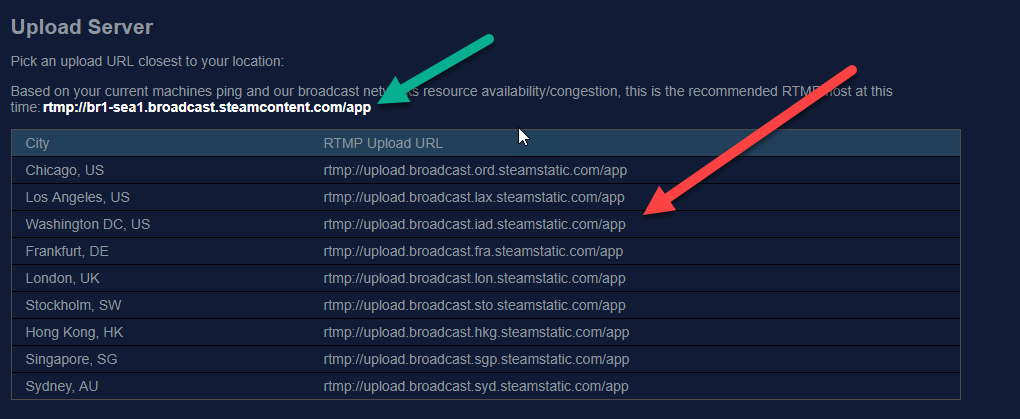
Example
Using the above as an example, I would send my live video stream to rtmp:/br1-sea1.broadcast.steamcontent.com/app and my game data to https://br1-sea1.broadcast.steamcontent.com/broadcast/76561198348711414/upload_gamedata where '76561198348711414' is my steamid which I use for live streaming.We recommend you send your game data to this API every 2-5 seconds. The game data can be a complete representation from the beginning of the streaming event.
POST Parameters
All of the parameters are required- appid : The app being streamed. If this appid changes with subsequent calls we will clear cache of any previous game data.
- rtmptoken : this is the stream key or the RTMP token you received from steamcommunity.com/broadcast/upload. This is the same RTMP token used to permit you to upload your live video data.
- gamedata : JSON game data. The format is described in the next section. Make sure to encode via base64
Game Data Format
{
"appid": 220;
"brackets": {
"name": "#bcast_TeamVsTeamMap",
"start": 1536104722301, // time is in seconds from epoch, Jan 1, 1970
"end": 1536107426249, // optional parameter; Supply when you know the bracket's end. We auto close a bracket if you open a new one.
"params": { // optional parameter; used when localizing your strings
"team1": "Alpha",
"team2": "Beta",
"map": "dust2"
},
},
"markers": {
"time": 1536107426249,
"name": "round 1", // optional parameter; Only shows as a tooltip when a user hovering over the tick marker.
"params": { "loctoken": "loc token" },
},
}
The string used for 'name' can optionally be tokens for localization (as in the example above). The parser will replace the token with the translations for each language; English is used as the fallback language if the customers language is not provided. There are no general localize tokens. You must define the tokens via the Rich Presence for the app. You can edit your Rich Presence in App Data Admin for your app. The above example would have the following localization in the apps Rich Presence in the following way:
"#bcast_TeamVsTeamMap" "%team1% vs %team2% | {#gamemap_%map%}"
"#gamemap_dust2" "Dust 2"
This would display on screen the following: 'Alpha vs Beta | Dust 2'
More information about rich presence tokens can be found here.
Reference
To see how CSGO thinks about the game data integration, you can look at this document. They can configure their CSGO game client to send game state data to any web server. They show an https://developer.valvesoftware.com/wiki/Counter-Strike:_Global_Offensive_Game_State_Integration to receive the data.
Here is an example of the code that CSGO team used to upload the brackets and markers to Steam Broadcast (not complete example, just the upload code segment): ExampleUpload.js